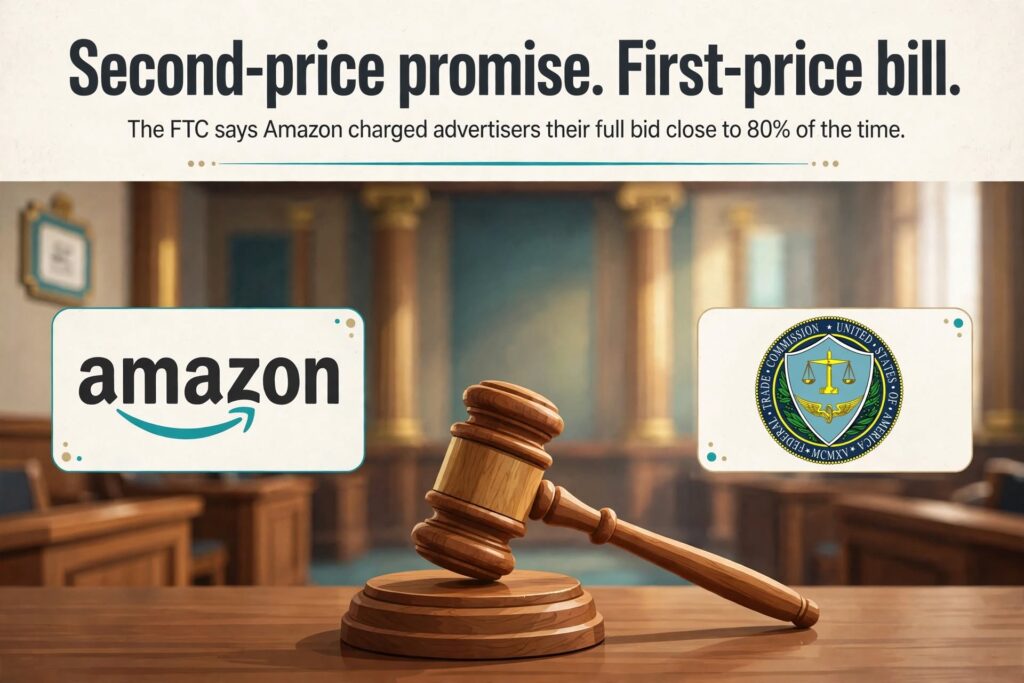
The FTC and 22 state attorneys general sued Amazon on August 31, 2026 and once you get past the legal language the core allegation is pretty simple. Amazon told Advertisers its Sponsored Ads ran on a second-price auction, where the winner pays roughly a penny more than the next highest bid. According to the complaint, starting around 2019 Amazon added a step after the auction closed. Since it can see every bid, it knows the winner and the real runner-up, and it allegedly slipped in its own internal bid price between the two, just under the winner’s bid, high enough to collect as much as possible without ever actually winning the slot. Internally it was called a “soft reserve price.” One document apparently called it “an invented auction participant.” The FTC says that by 2024 Sponsored Products Advertisers were paying their own full bid close to 80% of the time.
Amazon’s response, posted the same day, called the suit misguided. Reserve prices are common across the industry, nobody ever pays more than their bid, Advertisers set bids based on performance and not on auction mechanics, and its relevance-based ranking actually saved Advertisers money. Some of that is fair. Reserves really are common. But an auction where you pay your own bid four times out of five is a first-price auction, whatever the help page called it, and the help page is part of the problem. The complaint says Amazon left the “penny over second place” language up on its site until after it learned about the investigation.
Why this matters day to day: if you think you’re in a second-price auction, your bid is a ceiling. You set it a little high to win placements and trust that the market will keep the actual charge lower. If you’re really paying close to your bid most of the time, all of that padding comes straight out of margin.
What We Found In One Client’s Account
We didn’t want to wait on a court decision to determine whether or not this touched our own clients. So we went back through 26 months of Amazon data for one of our larger ecommerce clients, late July 2024 through August 2026. About $2.6 million in spend against $16.4 million in attributed sales. Sponsored Products, the product the complaint is mostly about, was 68% of that spend and 87% of the sales, so that’s where we focused.
The piece that made the analysis work was the bid history. In partnership with campaign management platform Intentwise, we pulled the client’s keyword-level bid change log. The data pull detailed approximately 194,000 bid changes across more than 20,000 keywords and we lined it up against performance metrics. That let us do something CPC alone can’t, which is separate actions we took in the bidding process versus what Amazon eventually charged us.
First finding, and honestly a bit of a relief: the account isn’t being quietly bled dry. Sponsored Products CPC went up about 25% to 30% over the period, rising from around $1.80 in late 2024 to a peak near $2.75 in mid-2025, then settled back around $2.30 through 2026. But return on ad spend didn’t slide with it. It held between roughly $7 and $9 the whole time, in line with client target ROAS goals, and 2026 has been one of the stronger stretches of our marketing efforts. I’d be careful about reading every CPC increase as a hidden surcharge. Most of them aren’t.
The second finding is where it gets interesting. We compared every major shopping event against the 21 days on either side of the event date, then splitting them into two groups: events Amazon owns, Prime Day and the October Prime Big Deal Days, and retail-wide events Amazon doesn’t, such as Black Friday and Cyber Monday. Then we checked what our own bids were doing in the two weeks leading in.
| Peak Event | Type | CPC vs. Base | ROAS vs. Base | Our Bids Going In |
|---|---|---|---|---|
| Prime Day 2024 | Amazon | +19.4% | -5.2% | No bid data yet |
| Prime Big Deal Days 2024 | Amazon | +14.4% | -15.1% | Raised (95%) |
| Black Friday / Cyber 2024 | Retail-wide | -7.3% | +5.7% | Cut |
| Prime Day 2025 | Amazon | +10.1% | -2.4% | Raised (66%) |
| Prime Big Deal Days 2025 | Amazon | +2.7% | -9.0% | Raised (62%) |
| Black Friday / Cyber 2025 | Retail-wide | +2.4% | +11.7% | Cut |
| Prime Day 2026 | Amazon | +20.6% | -13.9% | Flat |
Return on ad spend dropped on every single event Amazon runs, but went up on both Black Friday / Cyber Monday events. That pattern alone doesn’t prove anything, though, and I want to be upfront about why. On most of those Prime events we were raising bids going in, 95% of our changes before Prime Big Deal Days 2024 were increases. So part of the CPC jump on those events is on us.
Prime Day 2026 is the one that matters. Going into it, our bid changes were basically a wash, about as many cuts as increases, no net rise. CPC still jumped about 21% and return on ad spend fell about 14%. Same bids, much higher price. With our own bidding held steady, that lift came from Amazon’s side of the auction, and it’s exactly the kind of pattern the complaint describes.
There’s a limit to what this shows, and I’d rather say it than have someone else point it out. Amazon never exposes the bid behind each individual click, and the client’s performance and bid reports don’t share a keyword key, so we can’t calculate the exact rate at which this account was charged its full bid. What we have is strong, consistent evidence on one event. It isn’t courtroom proof, and CPC and return on ad spend move for plenty of other reasons.
It does feel familiar. Two years ago we looked at Google brand CPCs climbing with no change in competition and couldn’t prove why. Then the Google search ruling described pricing knobs that raised costs in steps too small to notice. Different company, same shape.
What We’re Doing About It
Not pulling back from Amazon. For most of the brands we manage it’s still where high-intent shoppers actually buy, and cutting budget over a lawsuit would be trading a real channel for a headline. But we’ve stopped bidding like the second-price promise is real. Max bids get set at the CPC the client can actually live with at their target return, not padded to win placements, because under first-price behavior the padding is just the price you pay. We benchmark against margin and assume current CPCs already have some surcharge baked in.
The biggest change is around Amazon’s own events. On Prime Day and Prime Big Deal Days we now hold or lower bids instead of raising them into the spike. The data says CPC climbs on those days whether our bid moves or not, so raising into them just stacks our increase on top of Amazon’s.
And we plan to keep exporting the bid change history. Amazon only keeps about 90 days of it natively, and the log we received from Intentwise going back two years is the only reason we could separate our bidding from theirs to produce this analysis. If the court ever orders restitution, the Advertisers who can document what they bid and what they paid are going to be in a much better spot than the ones who can’t. If you advertise on Amazon, I’d start saving your bid logs immediately. No idea how this case ends, honestly, and it could drag on for years.
If anyone else has run the same Prime Day comparison on their own accounts, I’d be curious whether yours looks like ours.