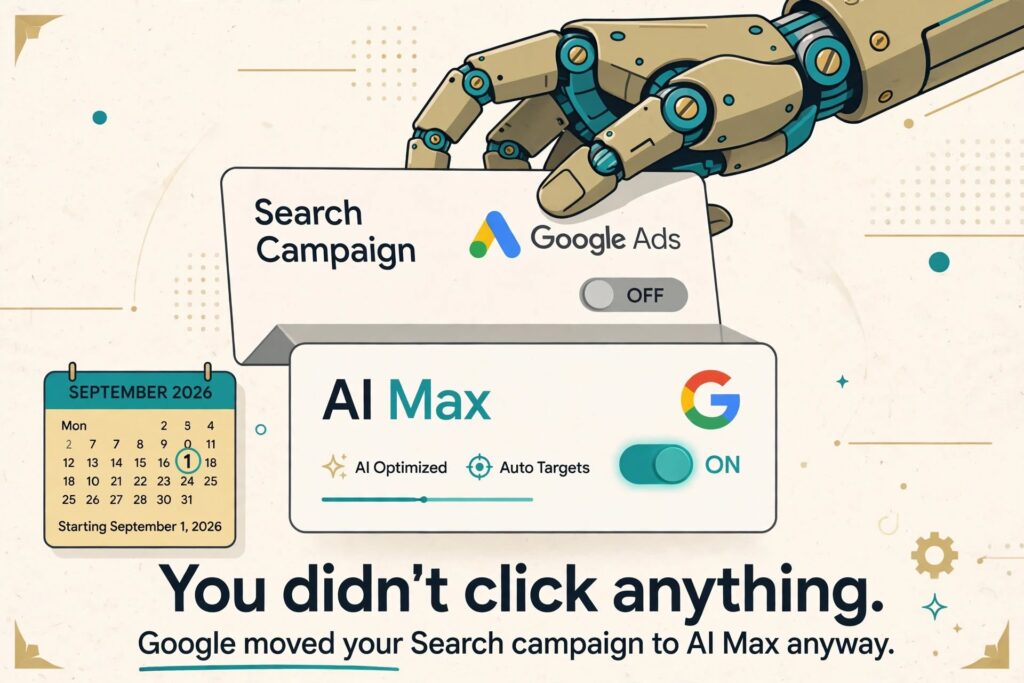
If you’ve logged into a Google Ads account this past week and found a Search campaign that suddenly says AI Max on it, no, you didn’t click anything by accident. Google started on September 1, 2026. Any Search campaign still using the campaign-level broad match setting or automatically created assets is getting moved into AI Max. A few at a time, through the end of the month. You can’t opt out of the move itself. New campaigns with those two settings have been blocked since August 3, 2026. Dynamic Search Ads are next, now pushed to February 2027.
They did warn us. I’ll give them that. AI Max came out of beta in April with this plan attached, the emails went out August 5, 2026 and the developer blog spelled out the settings a week later. So nobody got ambushed. It’s the auto-applied recommendations playbook again, where Google picks the default and you get to spend your afternoon undoing it. We wrote about that one when it launched, too.
Side note, and maybe this only bugs me. Automatically created assets doesn’t exist anymore as a name. It’s “text customization” now. Same feature, Google writing ad copy off your landing page, new label. I’ve lost count of how many times a setting I know has been renamed out from under me. Every time it happens somebody on a client call asks if it’s a new feature.
What Has Changed?
For some campaigns, not that much. Broad match campaigns get search term matching switched on and that’s about it: text customization stays off, final URL expansion stays off, brand inclusion and exclusion lists come along. Google’s word for it is “in-place.” And if a campaign was already running everything on broad, search term matching isn’t a huge leap. It was already matching to whatever Google decided was close enough.
The automatically created assets campaigns are where I’d look first. Those come over with search term matching and text customization both on. So now you’ve got Google matching you to queries you don’t have keywords for and writing the headline that shows up for them. Final URL expansion is still off for these too, which was honestly the setting I was most worried about. Credit where it’s due.
Why text customization matters so much to us: a lot of our clients are in insurance, healthcare and education, and ad copy in those accounts goes through compliance for a reason. A generated headline promising something legal never approved isn’t a performance problem. It’s a phone call nobody wants to make. We raised a version of this years ago when we asked whether Dynamic Search Ads were violating protected trademarks, and AI Max is basically that idea with more reach.
Then there’s brand. Search term matching doesn’t really care whether a query is your brand, somebody else’s brand or a generic category term, and we spent a good chunk of 2024 looking at brand CPCs that kept going up without a clear reason. My bet is a non-brand campaign with AI Max on starts picking up brand searches your brand campaign was already winning, cheaper. Those aren’t new customers. Same person, more expensive door. It’s the cannibalization problem we brought up when AI Max first launched, except now it’s happening to campaigns that never opted in.
Our week has mostly been going through accounts one campaign at a time. Check the AI Max setting, see what Google turned on, make sure brand exclusions actually made the trip, add brand lists where nobody set them up in the first place. Then filter the search terms report by the AI Max match type and see what the new matching is bringing in and how much of it overlaps keywords we already bid on. On the regulated accounts text customization is coming off until compliance signs off. Not up for debate.
We’re not turning AI Max off everywhere, though. You could. It’s one toggle at the campaign level, and Google says flipping it back on restores your previous AI Max settings. I’d rather leave it on where there’s enough volume to learn something and judge it on the whole account instead of the one campaign Google is giving the credit to. Some of these will probably be fine. A few won’t. I don’t know which yet, and I’d rather find out than guess.
If you’re running Dynamic Search Ads, you’ve got until February. Microsoft soft-launched its own AI Max this spring with full search terms visibility from day one, so this clearly wasn’t the only way to roll it out. Why does Google need it to be automatic and not just very strongly recommended? Adoption numbers, maybe. Or it’s just easier for them to run one version of Search. Haven’t figured that part out. If a migrated campaign did something strange in your account this week, I’d honestly like to hear about it.
Update, October 2026: The rollout wrapped up at the end of September. Google also quietly removed language targeting from Search campaigns in late September, so if a campaign was set to Spanish-only, that setting is gone and Google now decides based on the search. Worth a look if you run in-language campaigns.