
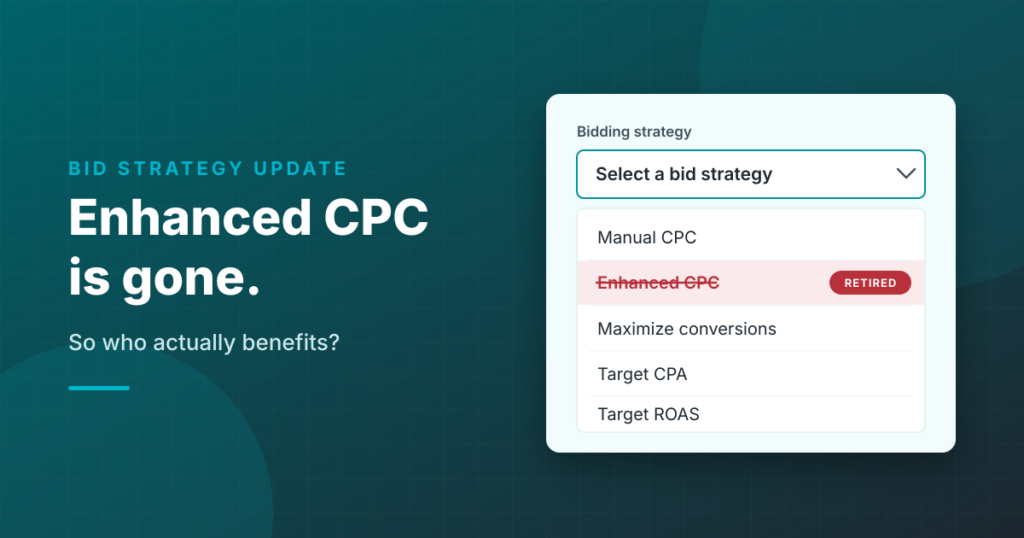
Back in September 2024, Google sent Advertisers an email letting them know Enhanced CPC was going away for Search and Display campaigns. By October you couldn’t pick it for a new campaign anymore, and by the end of March 2025 every campaign still running it got flipped over to Manual CPC whether you were ready or not. ECPC had been around since 2010. Fifteen years is a long run for any feature in Google Ads, so maybe it was simply its time. I’m not convinced that’s the whole story.
What Did Enhanced CPC Actually Do?
For anyone who never used it, ECPC sat on top of your manual bids. You set the price for a keyword, and Google was allowed to push that bid up when it thought a click was more likely to convert and pull it back when it didn’t. The Advertiser still owned the starting point. That’s the part that mattered.
We leaned on it for brand campaigns, for smaller accounts that didn’t have the conversion volume to feed a fully automated strategy, and for clients who wanted to test the waters on automation without handing over the checkbook. Microsoft obviously thought it was worth something too. When we wrote that Bing made Enhanced CPC its default, it was because Microsoft saw ECPC as the sensible on-ramp. Bing still offers it today. Google doesn’t.
Is This Really About Better Performance?
Google’s position is that Maximize Conversions, Target CPA and the rest of its automated strategies perform as well or better, and for some accounts I’d agree. An ecommerce shop doing thousands of orders a month with real revenue values passing back can get a lot out of automated bidding.
But it’s hard to look at this change by itself. In our October 2024 piece on brand CPCs we walked through the string of changes Google made after it restricted search term reporting in 2020. Broad Match Modifier went away. Expanded Text Ads went away. Performance Max launched with no negative keywords, and Smart Shopping got folded into it. Every one of those took a lever away from the Advertiser. ECPC is just the next one on the list.
Update September 2026: Google started moving Search campaigns into AI Max automatically. Now you can see where this was obviously heading.
Here’s what bothers me most. ECPC tied every auction back to a number the Advertiser chose. Standalone automated bid strategies don’t have that anchor. Google decides at auction time what your click is worth, and unless you’re running a portfolio strategy with a max CPC limit on it, there’s no ceiling you control.
We’ve seen what that looks like up close. When we moved one client’s brand terms from Manual CPC to an automated portfolio strategy in 2024, impression share went up 6% and click share went up 1%. Fine on the surface. Underneath it, Google served 29% more ads on search terms it labels “unreported” and charged 33% more for them, while CPCs on the terms we could actually see held flat. A little more visibility, paid for with spend we had no way to audit.
So Who Comes Out Ahead?
Google, first and foremost. More budget running through bid strategies where Google sets the price is good business for Google. That isn’t a conspiracy theory, it’s just how a publicly traded company makes decisions.
Big Advertisers with high conversion volume and clean data can come out ahead too, and I don’t want to pretend otherwise.
The ones who lose are smaller accounts, brand campaigns, and lead gen Advertisers optimizing to a form fill or a phone call rather than a sale. That last group worries me the most right now. If junk leads or bot calls are getting counted as conversions (and in home services we are seeing plenty of bot calls), an automated strategy will happily go out and buy you more of them. It doesn’t know the difference unless you tell it.
What Should Advertisers Be Doing?
First, go find the campaigns Google migrated for you. Anything still on ECPC at the end March has been sitting on plain Manual CPC ever since, and I’d bet a good number of those bids haven’t been touched in twenty months. That’s an easy fix hiding in a lot of accounts.
Second, stop treating Manual CPC like a legacy setting you need to apologize for. For brand terms and low-volume campaigns it’s often still the right call, and it’s now the only place in Google Ads where you set the price yourself.
If you do automate, put it in a portfolio strategy so you can cap CPCs, and get your conversion data right before you flip the switch. That means Enhanced Conversions at a minimum, and if you’re lead gen, sending qualified leads or closed revenue back into Google through offline conversion imports. Run it as an experiment and judge it on the whole account, not the one campaign. A campaign that gets better while the rest of the account slips hasn’t gotten better at all.
And on Bing, keep using ECPC where it makes sense. It still works fine there.
ECPC was never the most powerful bid strategy Google had. It was a compromise, and it was the last one. The real question isn’t whether automation can work. It’s who gets to decide what your click is worth, and Google has answered that one pretty clearly.