As of yesterday, Meta is using people’s conversations with Meta AI to decide which ads they see. Ask the chatbot about hiking boots and you’ll start seeing more hiking ads across Facebook and Instagram. Meta announced it back in October, carved out sensitive topics like health, religion and politics, and didn’t offer a real opt-out other than not talking to Meta AI. For Advertisers there’s nothing to switch on. It just happens inside the system.
That’s a small change on its own. But it’s the latest step in a year where Meta has been very clear about where it’s going, and the destination doesn’t have a lot of room in it for the people who used to run campaigns.
The Pitch, In Zuckerberg’s Words
In June 2025, the Wall Street Journal reported that Meta wants to fully automate ad creation and targeting by the end of 2026. A business uploads a product image and a budget, and Meta’s AI writes the copy, makes the images and video, picks the audience and suggests how much to spend. Around the same time Zuckerberg described it in an interview as the business telling Meta its goal, connecting a bank account, and skipping the creative, the targeting and the measurement, other than reading the results Meta reports back. He called it “a redefinition of the category of advertising.”
I’ll give him this much, it’s an honest description.
Most Of It Is Already Here
This isn’t a roadmap item anymore. Advantage+ is now the default setup for Sales, App and Leads campaigns, and the old fork in the road where you chose automated or manual is gone. Advantage+ Shopping became Advantage+ Sales. Age, gender and detailed targeting have turned into suggestions Meta can ignore, and the Opportunity Score is back, scoring you on how many of Meta’s recommendations you’ve accepted.
The AI chat piece is more interesting than it sounds, by the way. Someone asking Meta AI which running shoes are best for flat feet is giving off something a lot closer to a search query than a scroll. In theory that’s great for Advertisers. In practice, you’ll never see which conversations put your ad in front of someone, and there’s no setting that lets you lean into it or out of it.
We’ve been watching this coming for a while. Back in 2022 we wrote about Meta stripping out detailed targeting options, and the reasoning then was privacy. The reasoning now is performance. The direction never changed.
The Line That Should Bother You
It’s not the creative part, and it’s not the targeting part. It’s measurement. In Zuckerberg’s version you don’t need any measurement of your own, just Meta’s results. So Meta builds the ad, chooses who sees it, decides how much to spend, and then tells you how well it went. If a human agency pitched you that arrangement you’d fire them on the spot.
To be clear, I’m not saying Meta’s numbers are made up. I’m saying every platform’s attribution leans toward itself. View-through conversions, modeled conversions, generous attribution windows. They all make sense individually and they all point the same direction. When the platform also owns the creative and the targeting, there’s no outside check left anywhere in the loop unless you put one there.
So, Does Meta Still Want Your Agency Involved?
Honestly? Not the button-pushing part. Building ad sets, duplicating audiences, swapping images on a Tuesday to see what happens. That work is going away, and I won’t miss most of it.
What doesn’t go away is everything Meta can’t do for you. Somebody has to decide what actually counts as a conversion and send Meta real outcomes through the Conversions API, not just page views and form fills. Somebody has to give the AI something worth riffing on, because generated creative is only as good as the brand and product inputs behind it, a point we’ve been making about creative for years. And somebody has to tell you when your Meta budget should really be somewhere else. Meta isn’t going to be the one to say that.
In practice, that means we run consolidated Advantage+ structures because that’s how the system learns now, and we stopped fighting it. But we run holdout tests a couple of times a year to see what Meta is really adding, we reconcile Meta-reported conversions against the client’s own sales or CRM data every month, and nobody’s generated creative goes live without a person looking at it first.
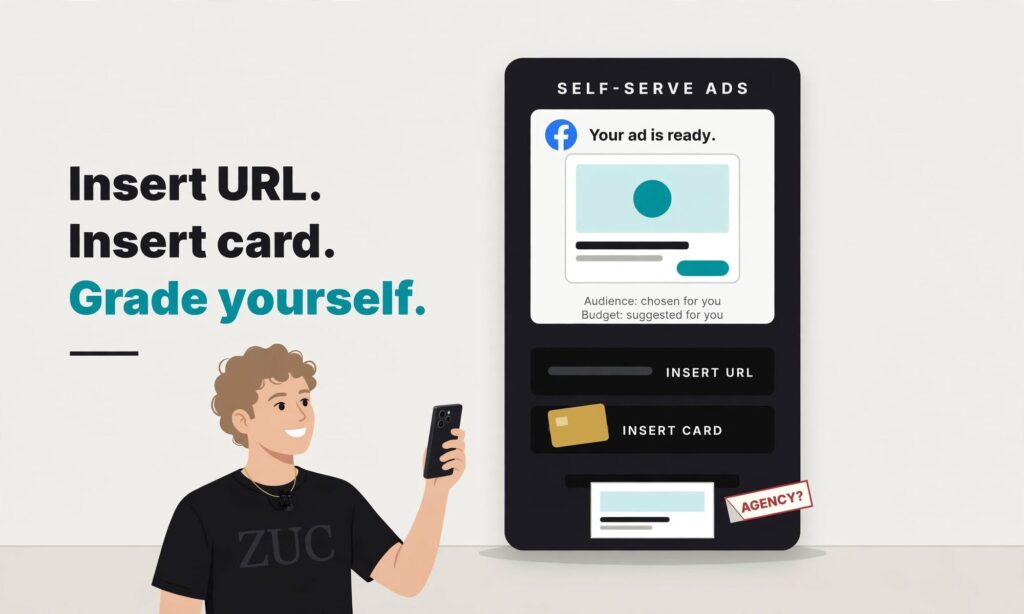
Meta wants your URL and your credit card. Fine. Just don’t hand over the teacher’s gradebook along with them.