Judge Amit Mehta handed down his remedies in the Google search case last Tuesday, and if you only read the headlines you’d think the story was Chrome. Google doesn’t have to sell it, or Android either. It can’t sign exclusive default search deals anymore, it has to share some of its search index and user interaction data with qualified competitors, and a technical committee will watch over all of it for six years. Alphabet’s stock jumped the next day, which tells you how the market scored it.
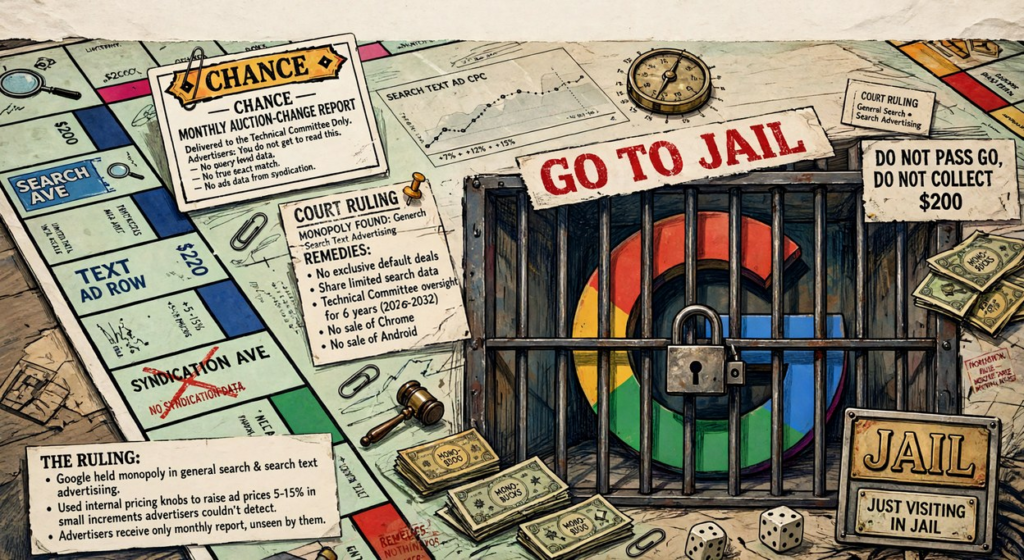
Here’s the part that matters to us. The liability ruling last August found Google held a monopoly in two markets: general search, and search text advertising. That second one is the market Advertisers actually pay into. So I went through the remedies looking for what was done about it.
The Pricing Knobs
First, the most damning thing in the whole opinion, and it got surprisingly little attention. According to the court, Google used internal pricing knobs to raise search text ad prices by somewhere around 5% to 15% at a time, in increments small enough that Advertisers couldn’t tell them apart from normal auction movement. Google’s own surveys found Advertisers noticed they were paying more. They just didn’t know Google was the reason.
I’ll admit that one stung a little. Last October we published our own brand campaign data showing CPCs on unreported search terms climbing far faster than inflation while click share and competition held flat. We couldn’t prove why at the time. Now there’s a federal judge describing the mechanism.
What Advertisers Actually Got
One thing, really. Google now has to report changes to its search text ads auction to the plaintiffs and the technical committee every month, flag which ones it considers material, and either publish a notice about those or explain why it didn’t. The idea is to stop Google from quietly fine-tuning prices upward.
It’s better than nothing. But notice who decides what counts as material. Google does, at least at first, with guardrails the plaintiffs and the committee still have to work out. The reports go to the committee, not to you, and anything that touches trade secrets stays private. I don’t expect a lot of public notices that say “we just raised your prices.”
What We Didn’t Get
The plaintiffs asked for remedies that would have helped Advertisers directly, and the court turned down the ones that mattered most. Google doesn’t have to give Advertisers more query-level data. It doesn’t have to bring back true exact match, which it watered down with close variants back in 2014. And it doesn’t have to share the ads data tied to the search ads it syndicates to other sites.
The query data one is the hardest to swallow. The court essentially said real-time data access wasn’t what the liability case was about. Fair enough legally, I suppose. But query visibility is the only tool Advertisers have to catch the kind of quiet price increases the court just described. You can’t hold an auction accountable when you can’t see what you’re bidding on, and Google has been taking that visibility away since it cut back search terms reporting in 2020.
Was Last Year’s Advice Right?
When the liability ruling came down, we told Advertisers to start diversifying beyond Google and predicted real change in the search market within 18 to 24 months. I’d still give the same advice. I’d just change the reason. The remedies won’t make Google cheaper. If anything changes, it’ll come from the rivals this ruling is trying to help, and from AI chat tools the judge himself pointed to as a reason not to go further. Neither one is going to lower what you pay Google next quarter.
So we keep doing what we’ve been doing. We log CPC changes against auction insights and impression share, so when prices move with no change in competition, we have it on paper. We keep Microsoft Advertising budgets alive even when the volume is small, because a second auction is the only real leverage an Advertiser has. And we’ll be reading every one of those auction disclosures, whenever they turn up.
A federal court found that Google could raise our prices without anyone noticing. The fix is a monthly report we won’t get to read. That’s about the size of it.
Update, October 2026: Not much has changed for Advertisers. Mehta entered the final judgment in December 2025 and it took effect in February. Both sides appealed, and arguments at the D.C. Circuit are expected early next year. According to court filings, Google told the technical committee this fall that it hadn’t made any material changes to the auction, which the committee says it can’t verify yet. The ad tech case ended the same way this September, which I wrote about here.