I watched the Google Marketing Live keynote at the end of May, and most of what stuck with me on the search side was about AI Mode. Conversational Discovery ads, where Gemini writes the creative around whatever the person just asked. Highlighted Answers, where your ad can land inside the list of recommendations AI Mode spits back. AI-powered Shopping ads with a little Gemini-written blurb on why your product fits. And something called a Business Agent for Leads, which is basically a chatbot living inside your ad that answers questions off your website so the person never has to fill out a form.
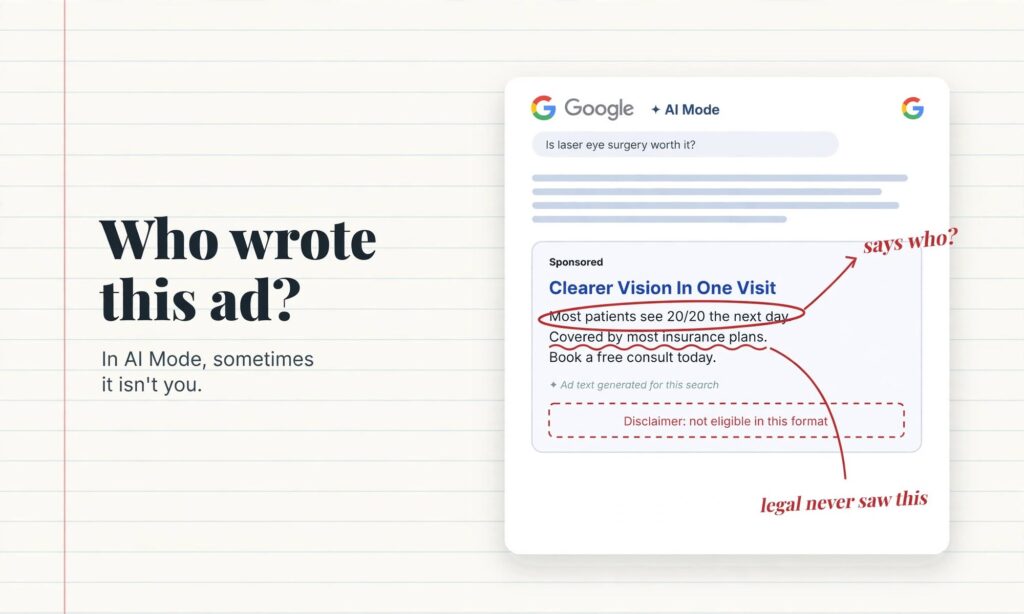
All labeled Sponsored. Fine. But a lot of the words in and around those ads aren’t ones anybody on your team wrote.
The part that actually got my attention came later, in a LinkedIn comment of all places. Google’s Ads Liaison confirmed they’ve been testing healthcare ads in AI Mode for a few weeks. U.S. only, English only, small. Up to now healthcare has been kept out of ads inside AI Overviews completely, same as finance, alcohol, gambling and politics, per Google’s own documentation from December. And there are two conditions on the test: no pinned assets, no text disclaimers.
If you sell plumbing or HVAC services, you can stop reading here.
If you work with healthcare, insurance, lending or schools, those two conditions are kind of the whole ballgame. Ever since Google made Responsive Search Ads the only option back in 2022, pinning has been how you guarantee the license number or the rate disclosure or the “individual results may vary” line actually shows up in the ad. Disclaimers do the same thing more bluntly. Take both away and a big chunk of these businesses can’t participate without breaking a rule somewhere. Prescription drug ads, which can’t run without their risk language, are shut out by design. I’d guess that’s deliberate, and for a first test, probably smart. I’ve just seen enough Google tests to know they don’t stay small. When they grow, eligibility stays attached to the same campaign types it always is.
Which, for the record, is Performance Max, AI Max with search term matching, Shopping and broad match. Exactly the list from when ads moved into AI Overviews last year. I keep writing that sentence.
The Chatbot Is The Part I Keep Coming Back To
Picture the AI Business Agent on a plumber’s ad. Somebody asks if they do weekend calls, the agent checks the website, says yes, books it. Great. Now put the same thing inside an ad for a drug rehab facility. Or a Lasik practice. Or a nursing school. Somebody asks about success rates, or whether insurance covers it, or what percentage of graduates get jobs, and a model is reading a carefully lawyered website and paraphrasing it back in real time. The website being fine doesn’t mean the paraphrase will be. And the name on the ad is the client’s, not Google’s.
I don’t have a tidy answer for this. A few of the clients we work with are in exactly these categories, and for now we’re mostly keeping them out of the AI Max side of things wherever their disclosures depend on pinning, which means they’ll miss some of these new placements, and I’m okay with that for a while. Nobody’s turning on a AI Business Agent for one of them until their legal team has seen what it says. We’ve also started reading landing pages a little differently, less “is this compliant” and more “what happens if a machine pulls this one sentence out and shows it to someone.” That’s a different read than most legal reviews are built for, and I’m not sure anyone has a good process for it yet, us included.
We sent our Google reps a list of questions about what controls are coming. Still waiting on most of the answers.
To be clear, I don’t think these businesses should sit AI Mode out forever. The questions people bring to it about a procedure or a loan or going back to school are exactly the conversations they want to be in. I just don’t want to find out what Gemini said about a client from a regulator.
Update, September 2026: Independent tracking of AI Mode this summer found growing participation from Medicare, senior care, and appointment-booking advertisers, while major prescription drug brands remained largely absent. The pattern aligns with current restrictions on pinned assets and text disclaimers. Google still does not provide AI Mode placement reporting, so tracking like this remains one of the few ways to see who is actually showing up.