Google announced AI Max for Search at the beginning of the month, filled in more of the details at Google Marketing Live last week, and the beta is now rolling out to every Advertiser. If it hasn’t shown up in your account yet, it will soon, and you can expect your Google rep to bring it up on the very next call.
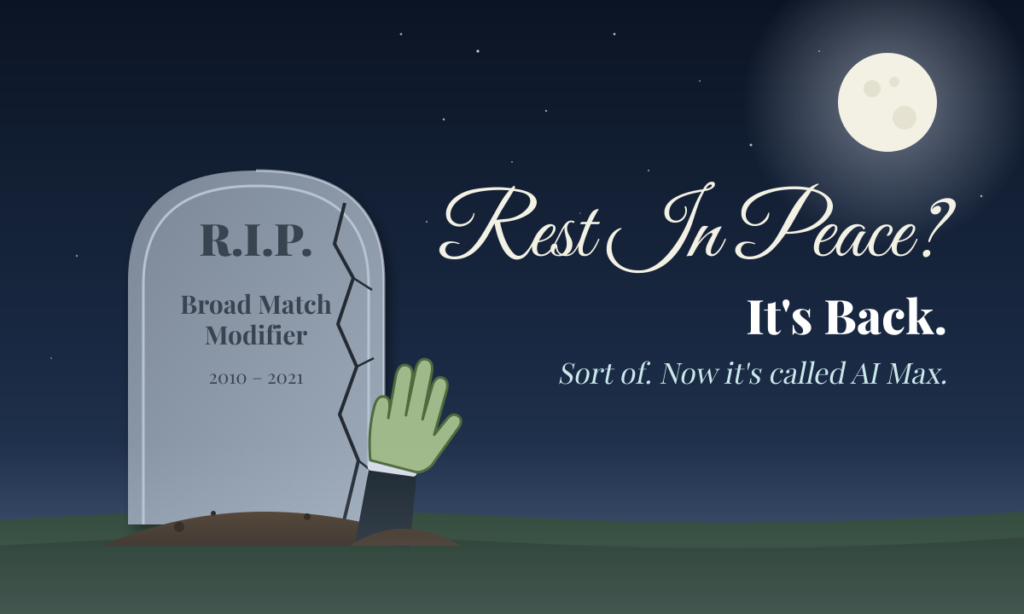
I’ve been doing this long enough to remember when Google retired Broad Match Modifier back in 2021. We wrote what amounted to a eulogy for it at the time. The official reasoning was that phrase match had been updated to cover the same ground. BMM allowed you to anchor the matching expansion of a keyword around certain words that were required to present in the query. Four years later we have a feature that will put your ads on searches that don’t contain your keywords at all.
What You’re Actually Turning On
AI Max gets pitched as a one-click upgrade, but it’s really three things bundled together. Search term matching uses broad match plus what Google calls keywordless technology to find queries based on your keywords, your ads and your landing pages. Text customization is the old automatically created assets with a new name, writing headlines and descriptions for you. And final URL expansion lets Google send the click to whichever page on your site it decides fits the query best.
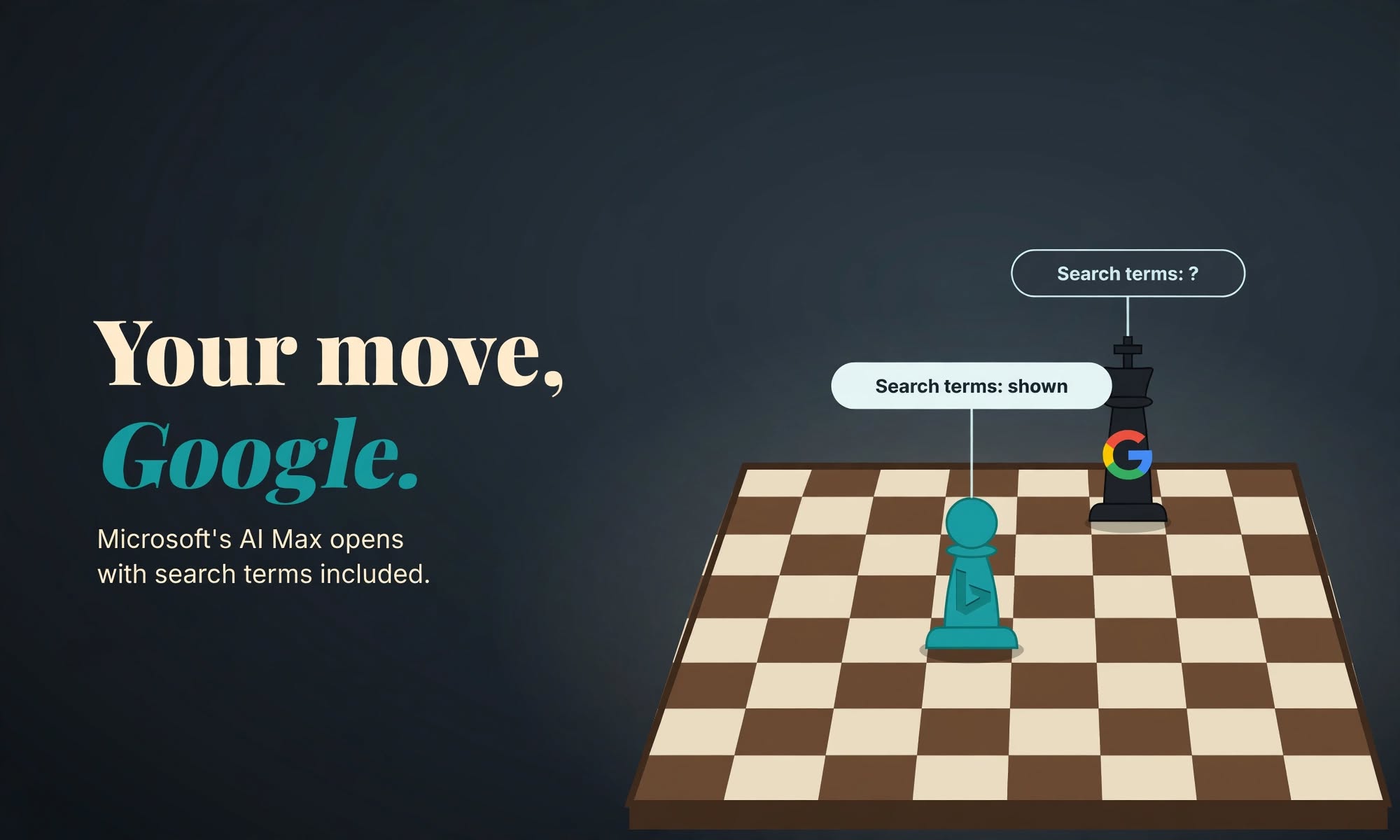
Google did give us some controls this time around. These tools include brand inclusions and exclusions, ad-group-level locations of interest, and a search terms report that shows which queries, headlines, and landing pages AI Max used. That’s a lot more than Performance Max had when it launched, I’ll give them that.
About That 14%
The headline claim is that Advertisers who turn on AI Max typically see 14% more conversions or conversion value at a similar CPA or ROAS, and 27% for campaigns still running mostly on exact and phrase match. Now go read the footnote. It’s Google’s own internal data, it excludes retail, and the 27% comes from campaigns where more than 70% of conversions were already coming from exact and phrase keywords.
Those are the tightest, most controlled accounts out there, which means they’re the ones with the most room for broad matching to go pick up new queries. Of course the number looks good there. The footnote fails to tell you how it counts these extra conversions, which matters more than the percentage.
Measuring It At The Campaign Level
My bigger worry is how people are going to measure this. Most will look at the AI Max line in the search terms report and ask whether those conversions were cheap enough. Wrong question. If a Target CPA campaign hits its goal overall while the AI Max queries run well above target, something else in that campaign got cheaper to make the average work. Usually that something is your keyword traffic. The bid strategy moves efficiency around inside the campaign. It doesn’t necessarily create any.
So the only honest test is the campaign as a whole, before and after AI Max was turned on, with nothing else changed in between. Did total conversions go up at the same cost? Did impression share on your core terms hold? If not, the “new” queries you’re paying for are mostly the old ones showing up in a different column.
Update, November 2026: We’ve since run exactly that test, a campaign-level pre/post lift study across multiple campaigns across three accounts. The short version: the AI Max line items ran well above Target CPA, while CPA on keyword-matched traffic fell enough to keep each campaign’s blended CPA on goal. The tested campaigns produced neutral results. Read the full AI Max case study for the full methodology and results.
So, Revenge Or Funeral?
Honestly, a little of both. Keywords aren’t dead. Google still uses them as the starting signal for everything AI Max does, and a keyword that matches the search exactly still gets priority. But a keyword used to be an instruction. Under AI Max it’s closer to a suggestion, and the system decides how far to wander from it.
BMM let you draw a line around a set of words. AI Max lets you draw a line around brands and locations, which is useful, but the line around meaning belongs to Google now. I’ll also go out on a limb: Dynamic Search Ads and standalone automatically created assets don’t survive another year and a half as separate features. AI Max does both of their jobs, and Google doesn’t keep two products around for long when one will do.
How Vincodo Is Rolling It Out
We’re not turning AI Max on across the board. For now it’s one campaign per account, with steady conversion volume and nothing else going on around it, switched on with a clean start date so there’s a real before and after to compare. No budget changes, no new ads, no bid target moves that same week. It’s fussy, I know. It’s also the only way I know of to tell AI Max actually helping apart from AI Max just reshuffling the deck.
Final URL expansion stays off on most of them for now. I’m not ready to let Google decide which page a click lands on because that page happened to convert well last week. Brand exclusions go in before launch, not after a competitor’s name shows up in the report. And on the lead gen accounts we’re double checking that the campaign optimizes to qualified leads rather than raw form fills, because AI Max will go find more of whatever you call a conversion, good or bad.
Google is probably right that this is where Search is headed. I’d just like to see it prove the lift with the whole campaign in the frame, and not only the column it utilizes to grade its own homework.