For one multi-location home services client, the invalid click credits from Google came to about $30K over the course of a month. What the bot calls actually cost them in agent time and lost bookings more than quadrupled the financial pain. That gap is why I’m writing this story to warn everyone that opportunity cost/loss must always be considered when conducting a post mortem analysis.
I’ll admit I was slow to take it seriously. For a long time a strange call here and there felt like the cost of doing business on the internet. Then the calls got weirder. Bursts at 3 a.m. Calls lasting the exact same number of seconds, 58 seconds to be exact. Area codes three states away on campaigns that only target one metro. Silence, or a recording beeps and boops, or a hang-up the second a person picks up. Anyone running call campaigns for a business where the phone is the conversion has probably seen some version of this over the past year.
Across our home services clients, bot and junk calls in a recent month ran about 30% of paid search call volume, up from roughly 10% a year earlier. That’s for Google and Microsoft both and any other channel that rings a phone. It isn’t one engine’s or media platform problem.
When you bring it up with the platforms, the answer is basically always the same. That’s right—ad platforms like Google Ads automatically detect, filter out, and credit back invalid clicks. Local Services Ads used to let you dispute leads, but not anymore. The flood waters of call bot fraud are heightening to dangerous levels.
For one thing, many of these calls never came from an ad click. Once a number is published anywhere (an ad, a landing page, a Business Profile listing) it gets scraped and dialed directly. With no click there’s nothing for the platform to flag or refund. In our data compiled from CallTrackingMetrics, about 50% of the suspect calls had no matching ad interaction at all. They still hit the call center. Depending on how the call tracking is set up, they can still count as conversions, and that’s worse than it sounds, because a 60-second bot call counted as a conversion tells Smart Bidding to go find more callers just like it. Without Enhanced CPC anymore (Google took that away last year) there usually isn’t a person anywhere in that loop to notice.
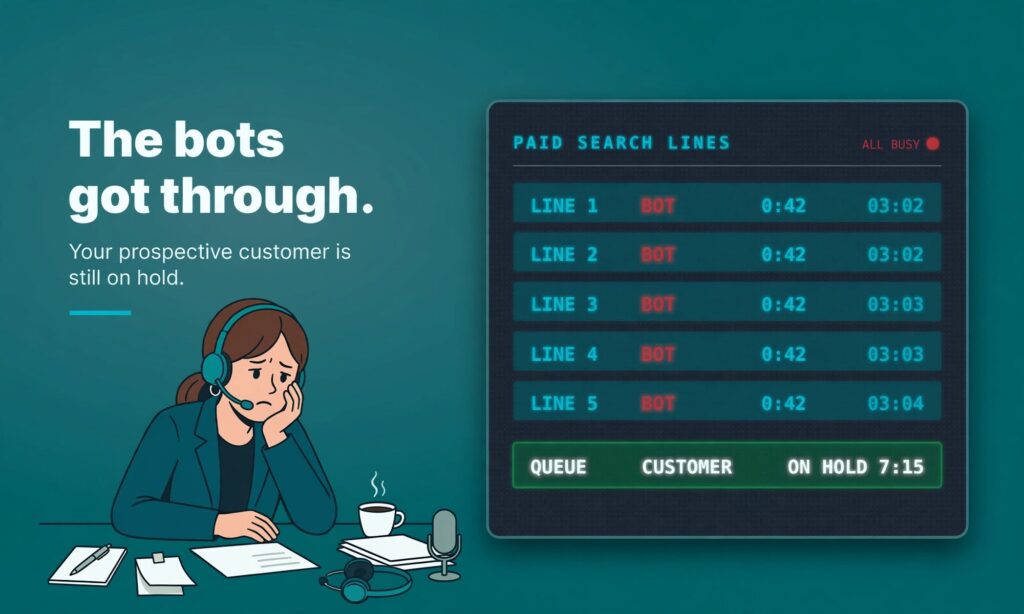
And then the call center. Every bot that reaches a live agent takes that agent off the board for a minute or two, while a real customer with water coming through the ceiling sits on hold. Some of them hang up and call the next company. Some routing setups even push repeat callers up the queue, which is about the most bot-like behavior there is. None of that shows up as a credit anywhere.
Putting a number on it gets messy. Labor was easy enough, bot calls times time spent times what an agent minute really costs with overhead in it. The lost revenue side we argued about, since plenty of people hang up on hold regardless. We ended up comparing abandonment during attack windows to normal ones and running that through booking rate and average ticket. It’s not perfect, but I’m comfortable with it being directionally sound.
What actually helped, more than anything clever, was giving every channel its own tracking number. Brand, non-brand, Performance Max, call assets, LSA, the Business Profile, Microsoft, Meta. When they all ring through one number an attack just blends in. Split them up and one number lights up while the rest stay normal, usually within a week. After that, match the call log against what each platform says it drove. A call in the log with no ad interaction behind it is almost always a scraped number.
The patterns aren’t subtle once you look: mismatched area codes, VoIP lines, identical durations, sequential caller IDs, the middle-of-the-night spikes. One client’s attack came almost entirely from a few area codes nowhere near their service area. A basic IVR prompt in front of the paid search numbers knocked out a decent share of the automated dialers by itself.
The bigger fix was changing what counts as a conversion. A call over some arbitrary length isn’t a customer. We send the platforms qualified calls or booked jobs through offline conversion imports now. For one account, this meant a custom integration with the client’s field service software such as Salesforce or ServiceTitan. It took a while. It’s the only reason the aggressive bidding stopped chasing the bots on the ad account.
On Giving Up A Number
Some numbers are just burned. Our rough rule is that if calls with no matching ad interaction stay well above baseline for two or three weeks after screening is in place, or the same caller patterns keep coming back, it’s time. Don’t just shut it off, though. Put up a new number, swap it everywhere on the same day. Send the old one to an IVR or voicemail for 30 to 60 days so real customers who saved it can still reach you. When nothing legitimate is coming in anymore, retire it. Don’t recycle it back into the tracking pool. A burned number tends to pick right back up on whatever ad it lands on next.
We wrote years ago about Google letting search arbitragers prowl because policing it didn’t seem to be a priority, and this has a similar feel. If anyone has actually gotten Google or Microsoft to credit calls from scraped numbers on their platforms, I’d honestly like to hear how. Their stance has been unwavering and firm that invalid click refunds are their only obligation, not the subsequent damage caused by their lack of policing and blocking of call bot attacks.