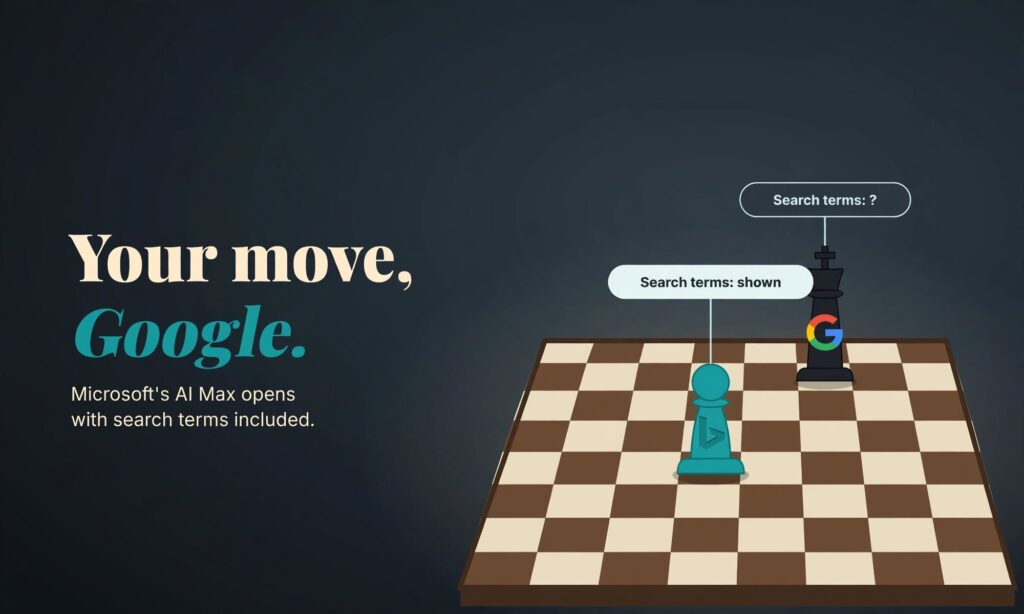
Microsoft Advertising unveiled its own version of AI Max last week ahead of its spring event, with pilot testing kicking off in May. If you read our take on Google’s AI Max last year, the basics will sound familiar. Broader query matching, AI-written asset variations, smarter routing to landing pages, and ads that can show up in Copilot’s answers as well as on Bing. Microsoft even borrowed the name. Somebody in Redmond clearly decided there was no reason to be subtle about it.
What caught my eye was one sentence in Microsoft’s announcement. Paraphrasing, it said that unlike other platforms, Microsoft has given Advertisers search term and asset reporting from the start. So you can see how the AI is actually driving results. “Other platforms” is doing a lot of work there. Everybody in this business knows who they meant.
Why That Sentence Matters
Back in 2020 Google cut back what it shows in the search terms report, and the reason given was privacy. Low-volume queries got hidden, which in practice meant a big chunk of spend landed in a bucket with no search term attached. In 2024 we looked at what that bucket was doing on one client’s brand terms. We found that the unreported queries getting more expensive much faster than the ones we could see. Then Performance Max went three and a half years before it got a real search terms report at all.
I’m not going to pretend Microsoft solved privacy. And to be fair, Google’s AI Max does show its matched queries in the search terms report, with the same low-volume blind spot as the rest of Google Search. Whether Microsoft’s version ends up more complete is something we’ll only know once the pilot is running in real accounts. But Microsoft just turned query visibility into a selling point, on an AI-driven product, on day one. That’s hard to square with the idea that keeping Advertisers in the dark was ever really about protecting users.
Microsoft is also promising the controls Google made us wait for. It’s worth noting most of them are listed as coming soon rather than here now. Brand inclusions and exclusions, term exclusions, and something it calls messaging constraints. This appears to be a way to guide the AI to what it is allowed to say about you. I’d like to see that last one in Google’s version too.
There were a couple of other things in the announcement worth a look if you sell products. Offer Highlights puts things like free shipping or in-store pickup right inside a Copilot shopping conversation, pulled from your Merchant Center feed. And Microsoft is expanding a free tool in Clarity that shows which of your pages are influencing AI answers and where competitors are getting cited instead of you. After what the industry research showed last fall about cited brands getting more paid clicks in Google’s AI Overviews, I’d have someone on your team poke around in that one.
I’m Not Handing Microsoft A Halo
Before anyone thinks I’ve gone soft on Bing, this is the same company that opted everyone into the Microsoft Audience Network automatically and made it a real pain to get back out. Microsoft pushes its own automation agenda as hard as anybody. It just happens to be the underdog right now, and underdogs compete on the things the leader won’t give you. Transparency is one of those things. So is keeping Enhanced CPC around after Google killed it.
I’ll take it, though. When the second-biggest search engine shows that you can run AI matching and still tell Advertisers what they paid for, it makes the conversation with the biggest one a lot easier.
We’ll be putting AI Max into the Microsoft pilot for a few clients in May. We will be using the same pre/post approach we use on the Google side. The first thing I’ll be checking is how much of the spend shows up with an actual search term next to it. If the number is as high as Microsoft is implying, I expect to be writing a fairly pointed follow-up.
Your move, Google.
Update, September 2026: In fairness to Google, Microsoft isn’t above taking controls away either. In August it told Advertisers that starting October 1, new standalone campaigns using Maximize Conversions, Maximize Conversion Value or Maximize Clicks can’t set a Max CPC anymore. Portfolio strategies, Target Impression Share and Enhanced CPC still keep it. Smaller step, same direction.